Native American Netroots
Menu
Border


Make a New Account

Username:

Password:


Forget your username or password?


Search


Advanced Search


Active Users
Currently 0 user(s) logged on.

Native American Netroots


...A Forum for American Indian Issues...

Native American Netroots

American Indian Alcoholism

by: Ojibwa

Fri Jan 01, 2010 at 15:37:46 PM PST


( - promoted by navajo)

One of the most common stereotypes about Indians is that of the drunken Indian, a reflection of a higher rate of alcoholism among Indians. While there are many who feel that Indians are biologically or genetically incapable of consuming alcohol in a "normal" fashion, research on alcoholism generally does not bear this out. The persistence of the idea that Indians metabolize alcohol differently and therefore get drunk on less alcohol and are therefore more likely to become alcoholic is based on the drunken Indian stereotype rather than on any scientific research on the etiology of alcoholism.
Ojibwa :: American Indian Alcoholism
Another common misconception is that Indian people did not have alcohol until the European invasion. While most Indian cultures did not include alcohol, there are some notable exceptions. Both the Tohono O'odham and the Apache, for example, produced alcoholic beverages long before the coming of the Europeans. The use of alcohol in these cultures, however, was generally ceremonial rather than social and as a consequence there is no evidence that it resulted in alcoholism.

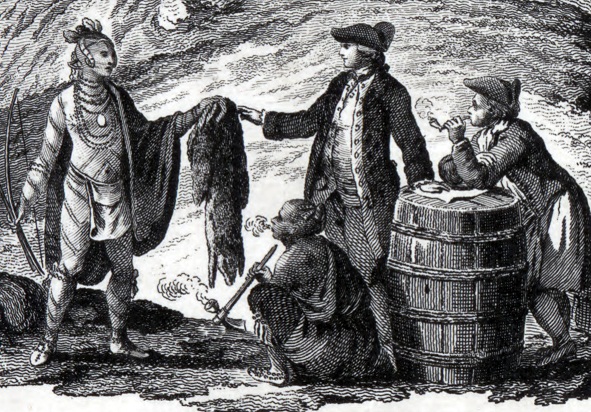
Indian people learned to drink European alcohol such as rum from people who were not "normal" drinkers. That is, the early frontier Europeans - the traders, the trappers, the explorers - were often social rejects in their own society. Many were alcoholics. The drinking pattern which they taught Indians was not the polite social drinking of upper class European society, but rather it was the alcoholic model of the lower classes. Indians learned from these people that the purpose of drinking was to get drunk and drunkenness was to be expressed in violence and anti-social behavior.

There are several dimensions to alcohol in European-Indian relations. First, traders liked using alcohol as a trade good for several reasons: it was something that Indians wanted; it was consumable and therefore Indians would trade for it again and again; it was addictive and therefore Indians would trade for it again and again; and drunken Indians were more easily swindled during trading sessions. Indian agents liked alcohol because drunken Indians were more easily swindled during treaty negotiations.

On the other hand, there were those who were against the use of alcohol by Indians. Many traditional leaders, seeing the damage created by alcoholism, have called for a return to traditional ways, ways which did not include alcohol.

In 1832 the United States passed a law which states: "No ardent spirits shall be hereafter introduced, under any pretense, into the Indian country." This total prohibition applied to traders and non-traders and allows no exception. During the next century, numerous laws - federal, state, territorial, and local - attempt to stop Indians from being able to obtain or consume alcohol.

The prohibition against Indian drinking continued into the twenties century. For example, in 1948 Congress passed legislation which allows Indians to use alcohol only for mechanical, scientific, or medicinal purposes.

In 1953 Congress ended the prohibition against selling alcohol and firearms to Indians. The tribes, with the approval of the Secretary of the Interior, were allowed to regulate the introduction of alcohol into Indian Country. As a result, there are some tribes which allow alcohol to be sold, possessed, and consumed on the reservation, while there are others that prohibit alcohol.

There are some who feel that the high rate of alcoholism and the high number of deaths which are alcohol related are a direct consequence of the federal prohibition against alcohol. This prohibition did not allow Indian cultures to develop their own norms for the use of alcohol.

Alcoholism is one of the most serious health concerns among Indians today. The death rate from alcoholism is often underreported for alcoholic death can be manifested in liver disease as well as in homicide, suicide, and death by accident and misadventure. In addition, alcoholism impacts children in the form of Fetal Alcohol Syndrome (FAS) and Fetal Alcohol Effect (FAE).

To combat alcoholism, treatment programs and education are needed. To be effective, however, these programs need to be culturally relevant. Alcoholics Anonymous (AA), for example, is generally viewed as an efficient treatment program for alcoholism. AA developed to meet the needs of middle class English-speaking alcoholics and tends to be most effective among Indians who are highly assimilated into American culture. When modified to reflect Indian values and language AA becomes more effective among Native Americans.

One example of an effective approach to dealing with alcoholism in American Indian communities is the Red Road to Wellbriety.

Wellbriety means to be both sober and well. It means to have come through recovery from chemical dependency and to be a recovered person who is going beyond survival to thriving in his or her life and in the life of the community. The Well part of Wellbriety means to live the healthy parts of the principles, laws and values of traditional culture. It means to heal from dysfunctional behaviors other than chemical dependency, as well as chemical dependency itself. This includes co dependency, ACOA behavior, domestic or family violence, gambling, and other shortcomings of character

On many reservations and in some urban areas, there are traditional ceremonies - such as the sweat lodge and the Sun Dance - which combat alcoholism through abstinence. In addition, many powwows are "alcohol-free" and promote abstinence and sobriety. These traditional approaches appear to be making inroads against alcoholism.  

Tags: , , , (All Tags)
Print Friendly View Send As Email

Societal problem (0.00 / 0)
Thanks for this great article, some things I didn't know yet. Alcohol should, if at all, be consumed under ritualistic pretexts. Unfortunately with "modern" society people resort to alcohol to try to ease their sorrow not realizing they're actually making it worse. Its understandable that some native Americans have fallen into this given the plight this ethnicity as a whole has been bearing (aside from the individual problems). But I'm confident that once a return to more traditional ways has been established and western society has undergone similar adjustments, this problem will vanish.

In Memoriam
Flora Sombrero Lind In honor of my mother, THE FLORA SOMBRERO LIND NAVAJO ENDOWMENT FUND has been set up to accept your donations. American Indian College Fund This scholarship endowment has been established at the American Indian College Fund to honor Flora Sombrero Lind, as an enrolled member of the Navajo Nation who was born at Inscription House, Arizona of the Many Goats clan circa 1925. This scholarship endowment is funded by Flora's family and friends who want to see Navajo students pursue higher education and carry on their great Navajo heritage.

Please leave a comment here if you donate.

Site Donations
- Please specify what your donation is for in the notes section of the PayPal window. Either propane for Pine Ridge or Rosebud or Hosting fees for this blog. --navajo
If you like to help Aji and Wings please mail a check to them at the address here: wingssilverwork.com Click the contact tab for address.

About
Border

Native American
Netroots


...a forum for the discussion of political, social and economic issues affecting the indigenous peoples of the United States, including their lack of political representation, economic deprivation, health care issues, and the on-going struggle for preservation of identity and cultural history


ABOUT US :

Publisher/Founder
navajo (Neeta Lind)

Executive Editor
Meteor Blades
(Timothy Lange)

Contributing
Editors

oke
Aji

Senior Historian & Writer
Ojibwa

Featured Writers
cacamp
winter rabbit
Mark Trahant
exmearden
Land of Enchantment

Veterans Affairs Correspondent
DaNang65

Contributing
Writers

SarahLee
Bill in MD
DeepHarm
TiaRachel
Kitsap River
4Freedom
No Way Lack of Brain
More...


NDN News & Links
Border

Native American Rights Fund
The Native American Rights Fund (NARF) is a non-profit 501c(3) organization that provides legal representation and technical assistance to Indian tribes, organizations and individuals nationwide - a constituency that often lacks access to the justice system. NARF focuses on applying existing laws and treaties to guarantee that national and state governments live up to their legal obligations. DONATE ONLINE


Border

Censored News :: Brenda Norrell
Indigenous Peoples and Human Rights News
by
Brenda Norrell


Border

Wampum

Border

Reznet News
Reporting From Native America


Border

Indigenous Action Media

Border

Indianz

Border

Indian Country Today

Border

Defenders of the Black Hills

Border

Leonard Peltier Defense Committee Leonard Peltier Defense Committee

Border

Native Vote
National Congress
of
American Indians


Border

Native News

Border

Earthsongs

Border

Native America Calling Border

Native Biz

Border

American Indian Tribes Forum

Border

American Indian Tribes Forum American Indian Tribes Forum

Border

American Indian Tribes Forum

Border

BLOG FATHER
- DAILY KOS


Border

BLOG BROTHERS
- NATIVE APPROPRIATIONS

Border


Native American Netroots

-HOME-


Powered by: SoapBlox